
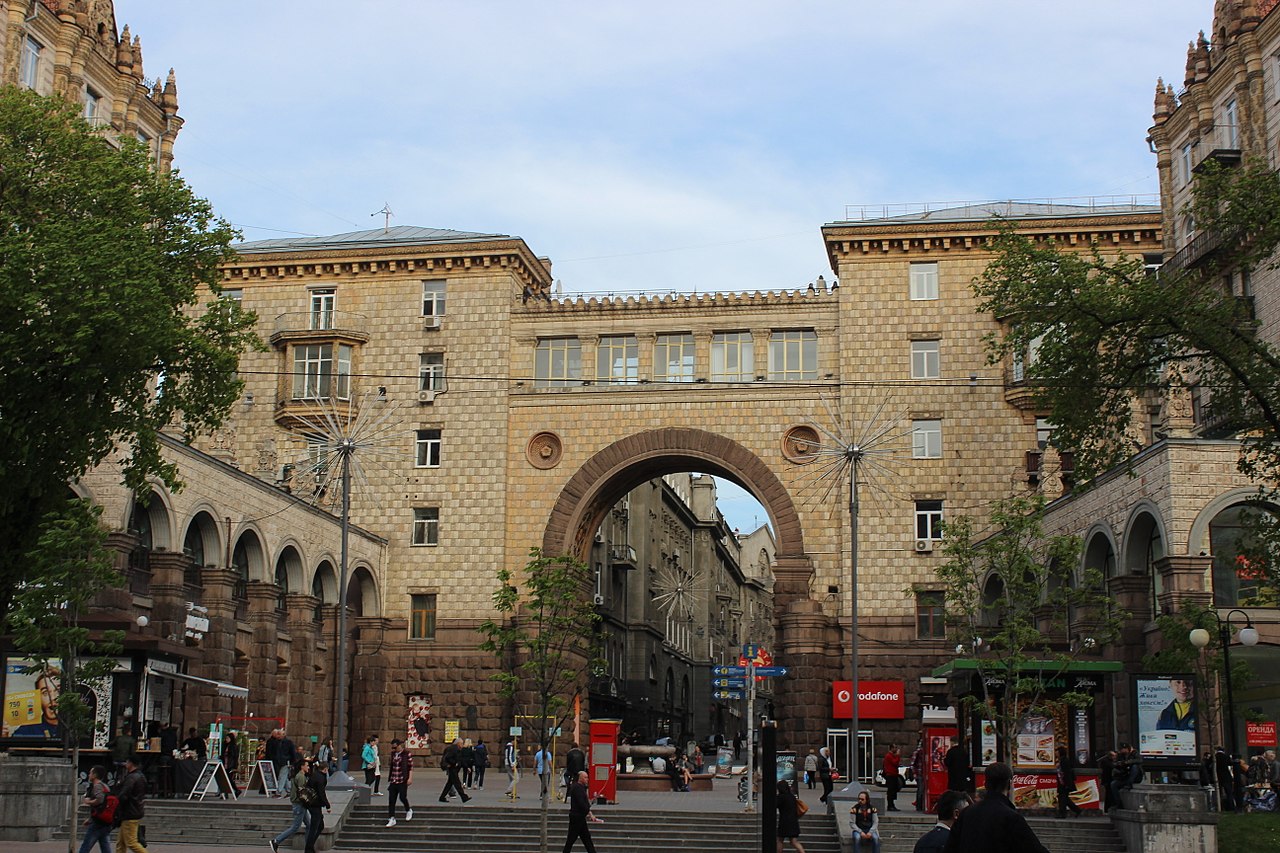
Kyiv Passage is an entire quarter designed as a street-corridor. The trend of constructing gallery houses or passages originated in Paris in the late 18th century. This popular architectural style made its way to Kyiv when the first Kyiv Passage was built at 38 Khreshchatyk Street in 1871. Unfortunately, this landmark was destroyed in a devastating fire on Khreshchatyk Street in 1941. The "new" Passage was constructed between 1913 and 1914 in the Neoclassical style, designed by the Kyiv architect P.S. Andreev. Today, this architectural feature serves as a corridor connecting two distinct parts of the city: the bustling metropolis and historical Kyiv. The facades of the Passage are a work of art in themselves, adorned with reliefs featuring antique motifs such as angels, mascarons, garlands, owls, and symbols of trade and banquets. Many visitors are particularly drawn to the bas-reliefs depicting mythological scenes. The building has been home to notable figures, including opera singers Borys Hmyria and Mykhailo Hryshko, composer Herman Zhukovskyi, famous actress Olha Kusenko, doctor Anatoliy Mikhnov, children’s poet Ivan Nekhoda, and writer Viktor Nekrasov. A notable story about the Passage is the tale of the Kyiv store of world-renowned jeweler Carl Fabergé, who ultimately could not compete with the local master, Iosyp Marshak. In 1910, the French jeweler was forced to close his shop. Kyiv Passage is a place where remarkable stories and legends intertwine. The two lower floors contain elite shops, boutiques, cozy cafes, and restaurants, while the upper floors house offices and apartments. For over a century, this unique street-corridor has remained one of the most beloved and romantic spots in the center of Kyiv.
Kyiv Passage
Photos


 Share on Facebook
 Share on X